Sunday, May 16, 2010

The way out is through

Less than a week after I posted the previous essay, I got notice that my job was being terminated as of March 31. I noted this in the comments to the previous post, and three readers have subsequently posted sympathetic, helpful comments.


Since that time, a lot has happened. 

Almost immediately after my notice, I sent an email to a large group of friends letting them know that I'd been laid off again and that I was looking for other opportunities for useful work, including referrals to my private practice. A day or two later, a friend referred me to a job he had been recruited for but didn't want. It was a Big Job, a significant stretch in terms of responsibility, substantive work, and  compensation, with a large hospital not far from my home.

While I was interviewing for that job (and progressing much farther than I though I would), I got a call from the general counsel from another large health system asking me to meet with her to discuss whether I could give her some help. She is a long-time acquaintance to whom I'd sent an inquiry and resume a few months ago. This was a very attractive opportunity because it would involve working with several former colleagues and with other top-notch people in an well-respected company. It would also give me a chance to practice health law from both a provider's and payor's perspective and make use of both branches of my expertise.

Also during this time -- April -- several private practice clients sought me out and engaged me, so I had quite a lot of work to do apart from my job seeking.

To shorten the story considerably, I was one of two finalists for the Big Job but was not chosen. I accepted the position with the other organization under almost ideal circumstances: four days a week, as an employee with benefits, through at least the end of the year and perhaps a few months past that. (Furthermore, I can ride my bicycle to the office in about an hour, or catch a bus on the corner, make one transfer, and step off a train literally at the office's front door.) 

I've been working a week now, and it feels good. Already, I'm being challenged with interesting, complex work that uses my experience and expertise, and in an office with good people I've worked with before. Unfortunately, I've been suffering all week with a serious virus that has attacked my respiratory system, especially at night which interferes with my sleep and makes my waking hours miserable. (When I cough-- which is both too often and not often enough -- I feel pain in my abdominal muscles in my cranium as my brain shakes around in it. It's nasty)

I do find myself wishing this was not a temporary position and that I could count on it going on indefinitely, but if I've learned anything it is that everything is subject to change and that any security that relies on human institutions is illusory. So I'm plowing ahead one day at a time, grateful for what I have, and trying to keep my private practice going in the meantime.

I heard someone say that the only way out is through. I've found this to be one of the wisest, truest adages I know of. It is how it was in difficult passages in the past, and it's no different now. It takes a lot of energy -- it is a lot easier to be on cruise control than to have to be awake all of the time. But I know, as much as I resist it, that being awake is the only way to be. 


Thursday, March 04, 2010

Life. Vocation. Work. Job.

This post started as a comment on Emily Rose Neeson's thoughtful post at Barclaypress.com on Christian vocation, but grew too long for that place.

I was laid off my previous job (after six years there) in December 2008. It was part of a reduction in force. I saw it coming for months. I wasn’t bitter about it: I was the guy I would have laid off if I was in my boss’s shoes, so at I didn’t have any feelings of unfairness.

It was a hassle, but it was also a relief. The job was well-paid, clean, safe,  and was a mere 15 minute bike ride from home, but I had no passion for it; I had a lot more to offer than the job asked for, and I felt wasted much of the time. I helped others by helping those in the large organization help those who helped others, so the connection between my work and its value was attenuated and often invisible.

So I didn't miss the work, though I missed and do miss my relationships with the people there, many of whom have also since been made redundant. Fortunately, we had saved an amount equivalent to about a year’s worth of expenses (not counting anticipated college tuition), and getting six months of severance pay, followed by unemployment compensation gave us a temporary financial cushion and I didn't feel panic, though the financial crisis and the recession that resulted (and which persists today) did shake my confidence quite a bit.

During 2009 I did a lot of thinking, exploring, relaxing into the question of vocation, and work. I explored a new field (nonprofit leadership), took a course in it at a local university (paid for by the taxpayers), and looked for opportunities in that new field. But times were hard and the market frozen. I did land a part-time opportunity that I was an excellent fit for, but then the  work was deferred indefinitely. So I kept thinking, mulling, exploring, dreaming.

It didn’t take me too long to conclude that at the deepest level I did not want to be employed, at least not full-time and not by a large organization. I did want to work, though, and to have that work provide me with the money I needed to live, and also to leave me the time to live.

So I started a home-based business – a law practice, focusing on estate planning (wills, trusts, etc.). I got the idea through some volunteer work and the suggestion of a friend. I found that I enjoyed the work: it was concretely helpful to people; it let me work directly with them rather than through an organization; there was a need for what I did and an underserved market (primarily middle aged, middle class people who haven’t planned for the care of their children and property when they become disabled or die and who can afford to pay a fair fee for basic services but don’t require complicated and expensive tax planning); the field was relatively new and challenging for me and I was in learning-mode which always makes me high; and it had the realistic potential for being sufficiently remunerative to support my family and the rest of my social obligations.

While I felt strongly that this is what I wanted to do, I was aware of the practical challenges and dangers. So I was never able to  -- I never let myself -- jump in with both feet. I told others then that I was wading into the ocean of self-employment and that I was, progressively, ankle-, knee-, then chest-deep into it. But I never let the water lift me entirely out of touch with the land and I kept looking for more traditional opportunities. This perhaps was a mistake that displayed a lack of faith and prevented me from giving the business my best energy; but I’m cautious at heart and it’s what I did.

The practice went OK at first with a steady if slow stream of paying clients. I was learning the field and found that learning it was a lot of fun (except for the tax aspect, which in estate planning is like saying you like surgery but for the blood), and I was exercising my right-brain people skills more strenuously and successfully as well as my left-brain analytical skills. I loved being independent and flexible. I made mistakes and learned from them. I found a few colleagues and fellow travelers down the same road. My volunteer work increased. I was exercising more. I felt proud to be producing rather than consuming wealth. It looked positive.

But, alas, time and nerve ran out. The practice stalled in the fall. Having to pay for our health insurance benefits under COBRA, even with the 65% federal subsidy, was unsustainable and became the brick that broke the camel’s back. In addition to that big fact, there were inner misgivings, too. I began to feel self-indulgent, embarrassed that others were subsidizing my project –working people who were paying for two-thirds of my health insurance and unemployment compensation, my children whose hopes of attending college were made uncertain, donors to the college who subsidized my son's attendance there, charities I could no longer support at previous levels, a loving and supportive spouse whose own plans and dreams were in jeopardy because of my lack of income, and so forth.

Eventually, these and other practical considerations, led me back into the world of being employed, in a temp position at first, and, as of January 20, full-time in a “permanent” (the word should always be qualified by quotation marks) position with our state governmenl. It’s a fine job with good people, though it pays 40% of my previous salary, requires 25% more hours in the office, and uses maybe 50% of my talent. If this sounds like whining, I’m not. I’m grateful. I repeat these facts to remind myself that I had it pretty good before and that now I’m simply working like most of the rest of my country works, though even now I enjoy certain benefits and some measure (however fragile) of economic security (i.e., a traditional pension) that many others don’t enjoy. And where is it written that one's work has to be comfortable and fulfilling?

I have never during my years of droneship forgotten that the workplace is part of creation, too, as fallen as the meetinghouse or the courthouse, full of broken and not-so-broken people, and a place for ministry. I do it in my small ways -- being unfailingly polite to high and low alike; providing honest and high quality work, no matter how mundane or unappreciated; cheerfully accepting criticism even from those unqualified to give it; making and strengthening the invisible fabric of social relationships, etc.

But is this new job my vocation? My calling? It is certainly part of it, but it’s obvious to me it isn’t the whole calling, or even pretty close. It isn't what anyone (especially me) would put on my gravestone. The job simply provides me with the basic sustenance to live and continue my volunteer work at meeting and in my community (though the reduction in “free” time and the need to earn extra money in evenings and weekends is making me feel overly stretched at the moment; something is going to have to give, I’m afraid). Even though we’ve had to half our support of some of the nonprofits we love, the job lets me do what we are doing.

Having let go, at least for the moment, of the ideal of being self-employed, I’m reverting back to my old attitude expressed in the title and refrain of a song by Charlie King: "My life is more than my work, and my work is more than my job."

Monday, January 18, 2010

Thinking of Dr King and Jesus

In meeting yesterday, I realized that Dr King has been gone for 41 years this coming April. He was 39 when he was murdered. He's been gone longer than he was here.


Then, in this morning's Star Tribune, there was a very good op-ed piece by Paul Gaston headlined "He had a dream, but there was more." In it, he reminds us that Dr King was a prophet for radical, biblical economic and political justice as well as a dreamer of love and peace. Dr King's diagnosis of the sickness of American society and the radical nature of the cure was much deeper and more pungent than the vapid "can't we all get along?" caricature of his message that predominates in the mainstream. This emasculation of Dr King's ministry began during his lifetime, such as when he was castigated for opposing the American war against the Vietnamese as "counterproductive" to the civil rights struggle, but it has gotten worse since his death.

Gaston heaps appropriate disgust with people like George Will, Rush Limbaugh, and Newt Gingrich -- people who opposed everything Dr King stood for while he was alive -- who selectively quote Dr King's words in an effort to pervert his ministry.

Gaston's point isn't novel, but it is a welcome reminder.

But what hit me today was how what has happened to Dr King and his ministry is exactly what it looks like was done to Jesus and his gospel in the years following his death. That is, the more we learn about the historical Jesus the more we understand him to be a prophet of radical political and economic reordering of society as well as a self-sacrificing, gentle preacher of love and repentance forgiveness.

The Jesus many of us learned about in Sunday School is a sanitized, feminized Jesus whose spiritual message has been torn from its concrete social milieu, resulting in a message that may comfort the afflicted but does little to afflict the comfortable. (This might have been the developmentally appropriate image of Jesus to teach to children in Sunday School, but it is appallingly inappropriate for adults.) Such an image of Jesus makes his crucifixion into punishment of a religious heretic rather than a political seditionist. He was both.

A core conclusion of the Jesus scholars is that Jesus's followers interpreted and applied his message -- and recorded it in the books of the gospels -- in a way that met the immediate needs of the post-Easter Christian community and cannot necessarily be trusted as a comprehensive record of Jesus's actual life and ministry. I do not accept the Jesus scholar's conclusions uncritically, but after seeing how Dr King's life and message has been selectively remembered, I am more sensitive to how that process might have worked after Jesus's death.

My point isn't so much that the Jesus portrayed in the gospels is wrong or inaccurate as much as it is unbalanced and selective. There is plenty of evidence of Jesus's radical social and economic critique in the record to indicate that that, too, was a central part of his ministry. To be more accurate, then, I should say that the imbalance and selectivity comes from mainstream interpretations of the gospels rather than the documents themselves.

Fortunately, the comprehensive documentary record of Dr King's life is far more likely to be preserved and easily available, but the mainstream interpretation of that record still drives the public mythology to distort Dr King's life and message into something it most certainly was not.

Similarly, those of us who are inspired by Dr King's political and economic message cannot ignore the fact that he came to that message as a minister of the Christian Gospel and a committed disciple of Jesus Christ; his prophetic social, political, and economic words and actions were the direct and necessary results of that primary commitment.


But even if it were not present, I would yet have to live with the meaning of my commitment to the ministry of Jesus Christ. To me, the relationship of this ministry to the making of peace is so obvious that I sometimes marvel at those who ask me why I am speaking against the war. Could it be that they do not know that the Good News was meant for all men -- for communist and capitalist, for their children and ours, for black and for white, for revolutionary and conservative? Have they forgotten that my ministry is in obedience to the one who loved his enemies so fully that he died for them? What then can I say to the Vietcong or to Castro or to Mao as a faithful minister of this one? Can I threaten them with death or must I not share with them my life?

(from "Beyond Vietnam," delivered at Riverside Church, New York, April 4, 1967 -- a year to the day before Dr King's death.)

So just as Christians have to be careful of over-spiritualizing Jesus at the loss of his social critique, Americans must be careful not to secularize Dr King at the loss of his religious core.

(Lest there be any misunderstanding: I am not saying that Dr King was the incarnation of the Living God in the way that I believe Jesus was. I am saying that the message of each -- which requires radical commitment and a willingness to die to this world -- has been hijacked to rationalize and defend a profoundly sick status quo.)

Two typos corrected and images reformatted 1-19-2010

Friday, September 18, 2009

Five rules of the world; or, Show up for your life and don't be ashamed

I recently got involved with Facebook, for a lot of reasons, which has kept me away from here. One of the reasons is Facebook's encouragement of short, quick pieces. But here's an excerpt from Anne Lamotte's wonderful little book, Operating Instructions that was too long for a status update. The book is essentially a journal of the first year of her life as a mother to her son, Sam. I liked it very much, and it's so typical of Lamotte's wonderful writing. (I've loved hearing her on the radio for years, but have begun to read her only in the last few weeks.)


It's a short chapter dated November 4, and is on page 100:
I had a session over the phone with my therapist today. I have these secret pangs of shame about being single, like I wasn't good enough to get a husband. Rita reminded me of something I'd told her once, about the five rules of the world as arrived at by this Catholic priest named Tm Weston. The first rule, he says, is that you must not have anything wrong with you or different. The second one is that if you do have something wrong with you, you must get over it as soon as possible. The third rule is that if you can't get over it, you must pretend that you have. The fourth rule is that if you can't even pretend that you have, you shouldn't show up. You should stay home, because it's hard for everyone else to have you around. And the fifth rule is that if you are going to insist on showing up, you should at least have the decency to feel ashamed.
So Rita and I decided that the most subversive, revolutionary thing I could do was to show up for my life and not be ashamed.

Saturday, August 08, 2009

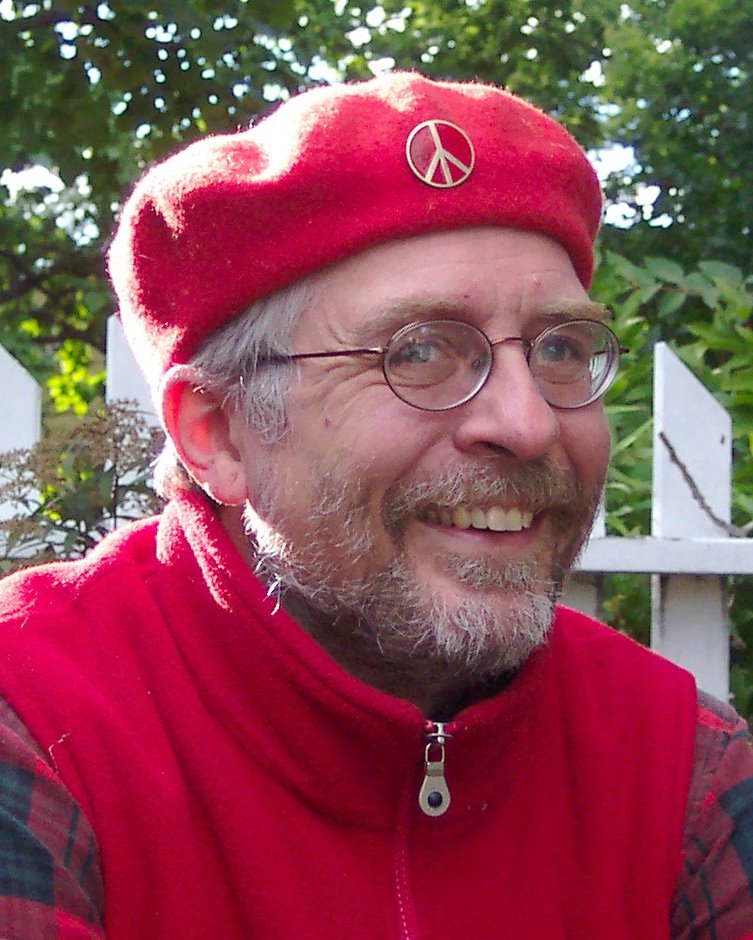
Peaceniks

Sunday, July 05, 2009

Let the time of joy return

July 5, 2009. I am near Indianapolis at Lovely Wife’s brother’s family’s home, relaxing on a beautiful screened in back porch amidst green trees and grass and the songs of hundreds of birds and a few stray Fourth of July firecrackers. We arrived last evening from Blacksburg, Virginia and the Friends General Conference Gathering.

At the Gathering, mostly I sung. I co-led an almost-three house workshop, Singing from the Sacred Harp, six mornings (one day was shorter), led an hour of singing from Rise Up Singing immediately afterwards, and coordinated and participated in a two-hour Sacred Harp singing Sunday-Friday afternoons. It was like heaven must be like.

The workshop went extraordinarily well. It is the fifth time I’ve co-led it, the first time with Gerry. We worked well together and are both very satisfied with how it went.

We had high hopes when we got the preliminary roster showing 43 registered participants, half men, half women. A dozen were of high school or college age young Friends (including four from our own meeting), and six other singers who had taken the workshop before. This gave us a solid core of experienced singers to help along the newer singers, always an advantage in a singing school.

There were some additions and subtractions, but on first session on Sunday morning the class pretty closely resembled the preliminary roster. From the very first song, we knew we had a solid group of singers. It turned out that most of the younger Friends were already singers with high school or college choir experience and they picked up the rudiments of shape note singing easily. We could have dispensed with teaching the parts of new songs by the end of the Monday morning, though we continued to sing the parts separately most of the time until Thursday. We kept having new participants drop in throughout the week, which also contributed to the quality of the experience.

The workshop was complemented by a very strong afternoon singing. For the fourth year in a row, we were provided a beautiful place to sing outdoors – under a wide cantilevered overhang of the dining hall. It wasn’t a low-ceilinged pine church, but it was resonant and we didn't have to strain our voices to be heard. We ordered 30 chairs originally but had to add 15 more by Monday afternoon to accommodate everyone who wanted to sing. (When the second group of chairs was delivered, we found all 45 of them set up in one giant hallow square – just as the workers thought they had been instructed.) Thankfully, singing Friends from Madison, Wisconsin and Lancaster, Pennsylvania, brought additional books to share with the ones I brought from the Twin Cities; without those extra books to loan, we would have lost many singers.

Although we missed the high school singers from the workshop during the afternoon singing (they were obliged to be elsewhere), we did draw many of the college age Friends from the workshop, some other adult singers from the workshop, and most importantly other experienced singers who were able to start the week strong and keep the singing at a very high level of quality. I have been very pleased with the growth of the size and quality of the afternoon singings over the past four or five years, and this year was even better. Surprisingly (or perhaps not), a large group also spontaneously showed up to worship and sing during the Wednesday afternoon sabbatical time when no organized activities were permitted. It was a pleasant coincidence.

Then came the extraordinary Thursday. In the workshop in the morning, we held a memorial lesson for Friends who had died or who were sick and shut-in and unable to be with us. This is a Sacred Harp tradition that we adapted to our Quaker setting by adding a lengthy time of silent, settled worship as well as reading the names and singing a song. It was, as it always is, a poignant and moving time.

We repeated this in the afternoon, with other names being said aloud and remembered by loved ones. Many of the names added in the afternoon were of people who had died prematurely, before what we would normally think of their time. I was led to lead the song Morning Sun (#436) which speaks to this tragic phenomenon:

Youth, like the spring, will soon be gone,
By fleeting time or conq'ring death;
Your morning sun may set at noon,
And leave you ever in the dark.

Your sparkling eyes and blooming cheeks
Must wither like the blasted rose;
The coffin earth and winding sheet
Will soon your active limb enclose.

Usually, this song is sung very quickly and energetically, and often with a strong feeling of black humor. But this time I led it very slowly and beat it with four beats to the measure, giving it a more stately feel. I also lead the song Poland (# 86) for the sick and shut-in:

God of my life, look gently down,
Behold the pains I feel,
But I am dumb before Thy throne,
Nor dare dispute Thy will.

I'm but a sojourner below,
As all my fathers were;
May I be well prepared to go
When I the summons hear.

But if my life be spared awhile,
Before my last remove,
Thy praise shall be my bus'ness still
And I'll declare thy love.

When these songs were done, we sat in traditional Quaker silent worship for a few minutes. While we were doing so, we listened to the background noise around us. Construction work across the street. Children squealing and laughing as they played down the walk. The easy laughter of Friends as they walked by, having a conversation. Sirens hurrying to the scene of an emergency.

Later that evening, I attended the Gathering’s third plenary program. The program began with a report from a Friend about a young man attending the Gathering who had fallen from a skateboard earlier that day and suffered a serious blow to his head; we had heard only that during our afternoon memorial lesson, and the speaker gave us his name and an update on his condition, which was guarded. He was not out of the woods and there was a strong sense of hopefulness for his recovery.

The speaker then began her program. It was the only one of the four plenary speakers during the week with whom I did not connect and so was relieved when she sat down at the end of her talk and was ready to leave.

But then a long line of Friends, most of whom I recognized as being part of the senior leadership of FGC and of the Gathering came to the stage and the general secretary stepped to the microphone. He then said words that must be among the most difficult he has or ever will have to say to others. He announced very simply and directly that Bonnie Tinker, a well-known and loved Friends from Portland, Oregon, had died that afternoon after having a collision with a vehicle while she was riding her bicycle.

There was an audible gasp from the assembly of a thousand or more. Then a lengthy time of stunned silence, punctuated by weeping and other sounds of emotion all around the hall. Lovely Wife took my hand and squeezed hard for some time. She had been a friend of Bonnie’s family for many years, and we both had worked briefly with her many years ago on an AFSC program. We knew her to be a remarkable woman of tremendous bravery, integrity, compassion, and promise. Her loss, in this sudden and unexpected way cut right through us.

After a time, additional announcements were made. All evening events cancelled except for a meeting for worship sponsored by Friends for Lesbian, Gay, Bisexual, Transexual and Queer Concerns, a community of which Bonnie was a leading member. Workshops would reconvene in the morning and leaders would decide how to proceed. Persons trained in Compassionate Listening would convene in the front of the hall, etc.

L.W. and I just sat there for ten or fifteen minutes, trying to come to grips with what we had just heard. Then I said to her, “All I can think of is to sing.” So we got a box of books and walked to the place where we did our afternoon singing, joined by a few others who we found on the way. On the way, we learned that the sirens we had heard during the memorial lesson that afternoon were those called to help Bonnie. In the end, there was about a dozen of us, and we began singing (uncharacteristically) quietly, given the circumstances and time of night, which gave the music a whole different quality. We aren’t used to exercising any restraint when we sing, and gradually I believe we came more into full voice. We sang an hour or so before we felt free to stop and go home.

I don’t remember all the songs we sang that night, but I do remember reprising the song Linda had called in the afternoon when I said I wished I had chosen a more hopeful song than Morning Sun.
She led Gainsville (#70t), verses 1, 5 and 6, and we sang it again that night.

Lord, we come before Thee now,
At Thy feet we humbly bow;
Oh do not our suit disdain;
Shall we seek Thee, Lord, in vain?

Comfort those who weep and mourn;
Let the time of joy return;
Those who are cast down lift up,
Strong in faith, in love and hope.

Grant that all may seek and find
Thee a God supremely kind;
Heal the sick, the captive free,
Let us all rejoice in Thee.

It is a strange thing in some ways to be so involved with Sacred Harp singing at a Quaker gathering. After all, it is difficult to think of anything that could be more different than traditional Quaker worship. We are not quiet; we are not still; we make noise, joyful and otherwise; we weep without shame and we laugh heartily and often; we probably refer to more biblical stories, verses, and themes in one afternoon than most FGC Friends do in an entire year of weekly worship

But I do not see this as contradictory. When the reality of life and death breaks through to touch me personally, I feel as if I have only two possible responses. The first, and most natural, is silent acceptance and contemplation, letting the reality of it all sink in without the aid or hindrance of words. I seldom feel that there is anything I can say under such circumstances that help me or anyone else. So I respond by simply being there, sitting quietly and attentively.

The other response is to sing. Mark Twain once remarked that “Under certain circumstances, urgent circumstances, desperate circumstances, profanity provides a relief denied even to prayer.” I find the same is true of singing. Under urgent, desperate circumstances I find that singing – especially from the Sacred Harp but also from other sources – gives me an emotional relief and connection to others that I do not ordinarily find in silent worship. I certainly felt this last Thursday night under the porch at Deitz Dining Hall.

The next morning, we set aside the first hour of our workshop for open worship after the manner of Friends. One participant shared the conversation she had had with Bonnie at lunchtime a few hours before she was killed. Another shared that it was appropriate that the reason Bonnie had rented a bike to ride during the Gathering was to continue her training for a long ride down the West Coast she was planning to raise awareness and funds for gay and lesbian families. Another asked the young people to sing the song he had heard them singing around the table at breakfast that morning – Mear, (#49b), a versification of Psalm 47’s lamentation. We sang these verses:

Will God forever cast us off?
His wrath forever smoke
Against the people of his love,
His little chosen flock?

And still to heighten our distress,
Thy presence is withdrawn;
Thy wonted signs of pow'r and grace
Thy pow'r and grace are gone.

No prophet speaks to calm our grief,
But all in silence mourn;
Nor know the hour of our relief,
The hour of Thy return.

After about an hour, we took a break and continued on the last day of he workshop, trying to wind things up and get in some last-minute lessons we had not had time to get to during the week.

Near the end, the general secretary came into the room and said that a television news crew was on campus reporting the story of Bonnie’s death and wanted to film a workshop in action as background footage for the story. He asked if we would be willing to be filmed; he said it would be more compelling than showing a bunch of people sitting around a circle talking. We agreed and the TV people came in and did their thing as we sang our final songs. A few minutes later, another crew came by and we again were filmed. You can see one of the stories here. (Thanks to Jeanne for forwarding this link.)

I am grateful to God for so many, many things, but after this week I am thankful for nothing so much as the ability to feel gratitude and for a voice with which to express it.

Wednesday, April 08, 2009

Palm Sunday meditation

From ministry given on 4-5-2009, North Meadow Friends Meeting, Indianapolis

Many years ago, I discovered Jesus and welcomed him into my life like a king. He was going to extricate me from a dead-letter childhood religion. He was going to give me ammunition to fight against an oppressive and regressive government and social system.

So I hailed his entry into my life with joy and elation. I carried and read from the little red book, Quotations of Chairman Jesus and quoted them to every overly cautious adult I could find. I even grew a beard and long hair and wore sandels to look like him. I was supported in my commitment by the fact that there were others who shared my point of view. It just made so much sense to me, and I took pleasure in kidnapping Jesus from the establishment that claimed to speak for him.

But after a while, things began to go wrong. As I ushered him into the temple of my heart, instead of reinforcing me in the reasons I asked him in, he began to point out that it -- that is to say, me -- was full of lies and lust. I was not what I pretended it was. And he didn’t just point out the discrepancy he brought out a whip and demanded that either the lies go, or he goes. But the hypocrites he chased out were old friends of mine, and I literally couldn't imagine being without them. So I began to hate him and plot what any Self-respecting person would do.

It did not take me long to neutralize him, as the military would say. It was surprisingly easy, actually. All I had to do was turn him from the powerful, Self-disturbing force I discovered he was into a mere teacher, prophet, philosopher, and a good example. I made him two-dimensional, like a cartoon figure, not a living being. In truth, I basically admitted what I had always thought about him, but without the pretense of his being anything more. So I wrung all the life out of him and buried him in the same stone sepulcher with the rest of them. In a honored place, at first, but what does it matter whose urn is on the upper shelf?

And I went on with my life.

But then something began to happen. Doubts arose. Was I certain he was nothing more than a good teacher or moral example? Was it possible that he was of a unique character? Perhaps even who he said he was? I no longer thought so, but I wasn't as certain as I once was.

Then I heard about a group of people who testified that they had actually found this dead prophet alive again. They reported that as they met together regularly to wait for him, he appeared to them in spirit and in truth -- simply, directly and unmediated by a priest or scholar. And that as they listened to him, they began to align their lives with his. There was something about their witness that was particularly convincing: it was not merely the testimony of their mouth, but of their lives that brought me to believe that they had, in fact, seen a Living Christ, and not the dead Jesus that I had killed so long ago.

And so I began to wait with them, and have been for more than 30 years now. I don't think I realized it at first -- in fact, hardly anyone in the group spoke in such terms at all -- but gradually I discovered that waiting for him -- and then listening to him -- was exactly what they were doing. While I can’t say that I’ve ever had as dramatic experience as the first-generation apostles as described by Luke, over the years I’ve had enough glimpses of the Living Christ’s presence in the midst of the waiting community that I have kept coming to wait with them.

Monday, January 19, 2009

Maybe this land was made for you and me after all

I have pretty successfully fought off Obama-fever for the past two years. He was my second choice early on, then my first, but I had not felt the thrill running up my leg like Chris Matthews did. Seeing him on television or hearing him on the radio, I found myself saying, "Yes, that's right" and agreeing with most of what he said, but it was more like watching a comedy movie and saying, "That was funny" rather than laughing out loud. Though I approved, I hadn't connected emotionally with him or his campaign, even on election night.

But it got me today. Lovely Wife and I listened to the concert at the Lincoln Memorial on the radio and then drove out to Costco (of all places) because we needed a pallet of pasta, a barrel of olive oil, or a side of beef or something. We enjoyed the music, but some of the readings seemed a little melodramatic and some of the music too show-bizzy for our tastes. Obama's speech was a good one, though, when it ended as we exited I-394 near the store.

Then Bruce Springsteen came on for the closing number and as he was talking we heard one unmistakable twang of a banjo and immediately knew that he was introducing Pete Seeger. (Isn't it funny how some musicians you can recognize after a single note?)

We'd heard Pete was attending the concert, but knowing that his voice is nearly gone we weren't sure he'd be performing. But then Bruce introduced him. (What did he call him? The grandfather? godfather? Father of American folk music?) and Pete rasped, "I'll say the words and you sing 'em" and then started, "As I was walking that ribbon of highway. . . ."

That's when the tears came.

Pete Seeger, 89 years old, who I first heard about when some right-wing Lutherans tried to keep him from singing at a Walther League convention in 1964 or so, who I first heard live at the Capitol in May 1971 singing Last Train to Nuremberg, who was blacklisted from radio and television but who nevertheless taught a generation -- nay, three or four generations -- to sing, song by song, campus by campus, demonstration by demonstration, during times of deep political and social darkness now singing with his grandson and a children's chorus and a half-million people at the inauguration of the President of the United States. We were just stunned with joy.

But what topped it off was that he didn't just sing the familiar four verses of This Land is Your Land that we all learned in grade school. He actually skipped a couple of those but did sing two verses Woody wrote that weren't printed in the school song books because they added a bit of social criticism to his otherwise safely patriotic song:

In the square of the city, in the shadow of the steeple,
Near the relief office, I saw my people.
As they stood there hungry, I stood there whistlin',*
This land was made for you and me.

A great high wall there tried to stop me.
A great big sign there said "Private Property."*
On the other side, it didn't say nothin'.
That side was made for you and me
* As sung. Woody's published lines are a little different.

That's when I really lost it and just sat there and wept. In the Costco parking lot, for heaven's sake. I felt gratitude for Pete Seeger -- and many others like him -- who for years were plugging away, little by little, sometimes with little to show for it, but persevering in spite of it all. God Bless the Grass indeed.

I finally felt, for the first time, really, some measure of hope for this country. Not because Barak Obama is any kind of all-wise and powerful superman who will make everything all right, but because the nation that managed to elect him as its president has some redeeming virtue left in it after all. As he said during the campaign, it wasn't about him, it was about us. I felt like calling to volunteer.

UPDATE: Thanks to Peggy & Songbird and finally figuring how how to embed a You-Tube file, here's Pete and Tao and Bruce and their fellow countrymen.

Friday, January 09, 2009

A faith of power or cheap moralism?

I just learned that Richard John Neuhaus died through this story in Slate.com by Michael Sean Winters. (NPR reported the story as I am typing this.)

I didn't know Neuhaus well, but followed his career at a distance from when he was a Lutheran pastor in Brooklyn and helped found what was then called Clergy and Laymen Concerned about Vietnam in 1966 or '67. An African-American friend of mine from college days adored him and she credited him with making sure that she went to college.

He was not a conventional liberal, however. He was a Christian, first and foremost, and he gradually found a more congenial home on the political right, and eventually in the Roman Catholic Church. His New York Times obituary is here and more comprehensive and much more sympathetic information is here.

What struck me was the following paragraph from the Slate.com story. I think it summaries my concerns about why the radical secularization of much of contemporary liberal Quakerism has weakened the power of our social testimonies. (The emphasis is mine.)

When religion is reduced to ethics, the church is permitted to enter the public square under the guise of a moral authority. But once you sever the link between the central animating dogmas of faith and the moral teachings that flow from there, you invite a cheap moralism, a religion of external conformity to prescribed norms rather than an internal assent of faith. You are a Christian if you believe certain things about events on a hillside in Jerusalem 2,000 years ago. It is that belief that has inspired believers and generated culture. Just last September, Pope Benedict XVI said that Christianity "is not a new philosophy or a new form of morality. We are only Christians if we encounter Christ."
I've long thought that the message that Quakers have been given to proclaim isn't that war is bad or that you should tell the truth no matter what or that you should not live ostentatiously. I think most everyone knows this already, and it is indeed cheap moralism for us to add to the scolding. What people don't know is how to live this way, how to find the courage to accept the suffering that comes from, for example, being conquered by an enemy rather than resisting with violence.

The unique contribution of the Quakers was to show the same God who shows the way to live and how I fall short of that way also offers me the power to follow that more excellent path; I am not inherently doomed to falling short of the goal as was the central premise of the protestant churches in England.

Whether or not Neuhaus was right or wrong about politics in the latter half of his life, I am certain that he was on the right track in insisting that the religious commitment precedes and informs everything else.

Monday, January 05, 2009

Hello babies. Welcome to earth. . .


It’s hot in the summer and cold in the winter. It’s round and wet and crowded. At the outside, babies, you have about a hundred years here. There’s only one rule that I know of– God damn it, babies, you’ve got to be kind.-- Kurt Vonnegut, Jr. in God Bless you Mr. Rosewater or Pearls before Swine.

So here they are, Edward (Teddy) Louis & Quinn John, born Saturday, January 3, 2009, in New York, not too far from where the author of this quote lived in mid-Manhattan. They, and their beloved mother and their worthy-of-her father are doing well, considering. They hope to go home to their fourth-floor walkup (!) in Brooklyn on Wednesday morning. Their uncommonly youthful grandfather will visit them in mid-February after a board meeting in Philadelphia. He can hardly wait

We were visiting Lovely Wife's family in Indianapolis when the word came -- via text message from their dad a lá Obama at 6 am that only Only Son could receive since we're too cheap to accept text messages -- on Saturday when we were leaving to visit daughter #2 in Dearborn, MI. On the way there, we discovered that Dearborn is closer to New York than it is to Minneapolis, and for several exciting hours we considered driving to New York the next day (Sunday) to see the two little lads.

But alas, saner and much less romantic heads prevailed ("What would we do without them?" our clerk asks) and we drove home on Sunday.

On the way home, we almost collided with a van that sped past our car in the early-morning darkness east of Jackson and began to fishtail on the glare ice on the roadway and then spin two or three 360s in front of us before it plunged off the side of the road into a ditch. All I could do was take my foot off the gas and plan for a diversionary maneuver if necessary, which it fortunately wasn't. We were shaken, to say the least, but otherwise undamaged, other than re-running the mental tape repeatedly.

* * * * *

So much more has been happening here than I can say. In October, I was happy to share a dinner and conversation with Brooklyn Quaker while in New York visiting my daughter. The day I returned home, I was notified (not unexpectedly) that my position was going to be eliminated on Dec. 1 and I have been enjoying a paid sabbatical ever since. The paid part will continue for a few months while I try to find new work, for which I am grateful.

I'm working at finding new remunerative employment, but I feel a little like St Augustine who said, "Give me chastity and continence, but not yet." I'm already as chaste and as self-restrained as I care to be, but I would like a little more time before I must abandon sloth . . . . *

* I happily note that none of the seven cardinal virtues -- humility, liberality, brotherly love, meekness, chastity, temperance, and diligence -- necessarily includes anything like toil or ambition. Whew.

Sunday, November 02, 2008

Born to Live

When I was a freshman in college, our 9:05 classes ended at 9:55, and then there was a chapel break after which the next class started at 11. I went to chapel sometimes, but one day I didn’t and went to my dorm room. I turned on the radio, which was tuned to the classical music station I liked to listen to.

But that day, there wasn’t music, but his voice, this rough, gravely voice, full of energy and passion, asking questions. I have no idea who the guest was that day, but it was my introduction to Studs Terkel. It didn’t take long for me to realize he was a gem, and for the twenty years I lived within the signal of WFMT, I was a regular and devoted listener. When I was unable to listen to the show in the morning, I listened to the Sunday evening rebroadcast.

I have three particular memories of Studs’ broadcasts. In 1981, I was unemployed and staying home with the kids and listened to Studs each day. On Monday, he said that his friend, the Chicago author Nelson Algren, had died, and was going to devote the week to him. There were a couple of interviews with Algren and some of his friends, but the bulk of the week was Studs reading from Algren’s works. I was sort of familiar with the Man with the Golden Arm, but nothing else of Algren’s, and now when I read him I hear Stud’s voice.

Algren is an unjustly under appreciated writer – he thought so, at least – but not by Studs. He understood Algren and obviously loved him and his work. (He was a founder of the Nelson Algren Committee that got Algren's work back in print.) I’ve been an Algren fan ever since.

The second memorable broadcast was really a brief excerpt a show, the context of which I can’t remember. Studs was interviewing his friend Mahalia Jackson in the hospital where she was recuperating from something or another, and while he was there Dr. Martin Luther King walked into the room to visit her, too. Studs left the tape recorder on recorded the most beautiful interchange between Mahalia and her friend Martin, absolutely authentic, full of love and humor, with some mild teasing if I’m remembering correctly. It is the only recording I’ve ever heard of Dr. King in a candid, non-public situation.

Finally, there is an one hour show he produced in 1960 entitled “Born to Live.” I think it puts everything about Studs’ life as a radio person and his message to the world. WFMT broadcast it mid-morning each New Year’s Day, and after having obtained a copy of the Folkways-Smithsonian CD, I continue the tradition to this day.

Here is how Studs describes the program:

With Born To Live I had the help - more than the help, the collaboration - of Jim Unrath, who was an announcer at the station. He and I worked together on all the documentaries, and all on his own time. As I told you earlier, I'm inept mechanically. Jimmy gathered all the stuff. He knew the way I was thinking. Born to Live is a collage montage of voices.

How to explain this? There was a contest called the Prix Italia. It's the equivalent of the Nobel Prize, you might say, for radio and TV documentaries and features. And Dennis Mitchell had won it for Morning In The Streets. So Rita Jacobs said, “Let's submit it.” Well, very few American stations ever win. It's won by BBC or Stockholm or wherever.

So I thought of all the interviews that I had, and there's this one that was sponsored by UNESCO as a special interview. It was 1961, I think, that we started doing it. The Cold War was going on pretty hot. And UNESCO says, “Can't there be one program of East/West values to lower the temperature of heated discussion?”

What came into my mind when we decided to enter the contest - with the odds about a thousand to one - was interviewing a hibakisha, one of the Hiroshima maidens, they were called, who survived the August 9th atomic bombing. She was talking through an interpreter. She’d been brought by the wife of a Quaker who ran that ship The Golden Rule, challenging the nuclear stuff. As she talked, I thought, “I’m going to open with that.”

And then I thought of other tapes I’d done. One of a street worker talking to a kid, a tough kid who's got a tattoo that says “Born To Die”. There are tattoos on his fingers: die, death, D-E-A-T-H. The street worker says, "What about the time between you're born and the time you die? What about that?"

“I don't know. What is it?”

And then I say, “Time to live.” See? And then snip. [snaps]

Little thoughts. And music. Pete Seeger doodling on a banjo, but he's doodling the chorale from Beethoven’s Ninth. Then it cuts to someone else - two couples in a suburb talking about their kids: “And so she says to me, ‘Well, might as well live today, tomorrow you're gonna die. I don't know how long I'll live.’” :How old is she?” “Nine.” And in between and interspersed are children's songs, American children's songs and Japanese children's songs. And then finally I say, “Born to live. What about the time between you're born and the time you die?” Then all the voices start. Some dealing with humor and laughter and some dealing with myth and legend, and the voice of Jimmy Baldwin and the voice of Miriam Makeba, the voice of Einstein. And John Ciardi says, “Sometimes you can tell the difference between a large decision and a small decision. Sometimes it's the sound of it. When I was a kid I used to hear Caruso records. I heard them in these Italian households in Providence, Rhode Island, I’d hear these Caruso records. And you think, ‘That’s as far as a human voice can go./ And there he'd go one step further.” Then I slip in the voice of Caruso singing “Oh, paradisio,” as he goes one step higher. And then Charlie saying, “ . . . .tell the difference between a small decision and a giant decision.” Then it cuts to the voice of Sean O’Casey, and Einstein, and Bertrand Russell. And then it cuts to the voice of a child.

In any event, it had everything. But I was influenced by Dennis Mitchell as well as by Norman Corwin. Sounds need not have a narrator. I got that from Mitchell. Just let the ideas flow from one to the other.
You will never spend a better hour than listening to this program.

Studs died last week, at 96. He'd been frail, especially after a recent fall, and practically deaf they say. I last saw him in 2002 at Macalester College in St. Paul. He was on a book tour promoting his book, Will the Circle be Unbroken, an anthology of interviews with people about death and what happens afterwards.

I can't imagine that he had any regrets at the end except possibly one: that he didn't live to see his fellow Chicagoan, Barak Obama, win election as president of the United States. He died knowing it was going to happen, though, like Moses maybe.

As he always signed off his broadcasts, "Take it easy, but take it."

Tuesday, September 02, 2008

We march in love: Further reflections on the RNC in St Paul


To continue from the previous post, our friend was not arrested and did not have to seek sanctuary in the meetinghouse except for Saturday night. She did have a frightening conversation with the Ramsey County sheriff who told her that she was indeed "on the list" but had not been arrested -- yet -- because she was perceived as a moderating influence on the young people in the RNC Welcoming Committee. So she is safe for the time being. (You can hear from her, and others on the RNC WC in a lengthy and provocative press conference here.)

It's too much for me to comprehensively update on the situation in St. Paul regarding the Republican National Convention and the protests surrounding it. Suffice it to sat that total arrests exceeded 800 and that many people here are very unhappy with the law enforcement responses. Here are some links that tell much of the story:

Minnesota Public Radio has excellent coverage here and elsewhere on its site
Democracy Now! and here and here and elsewhere.
Glenn Greenwald at Salon.com and here and here
Minnesota Independent and here and here and here and elsewhere on its site

As far as I know, there was no organized, corporate Quaker presence or response to the RNC, but many Quakers were involved in the week's events in different ways. Several dozen of us participated in the largest public protest of the week, a march of 10,000 on Monday afternoon.

Some worked as "field medics" to provide first aid to marchers and other protesters and some worked in a healing center across from a hospital the entire week; others worked all week on the Minnesota Peace Team, yellow-tuniced people trained to keep a buffer between police and protesters. Some helped set up and staffed the American Friends Service Committee's Eyes Wide Open installation on the State Capitol lawn on Tuesday. A few of us were legal observers and volunteered with the National Lawyers Guild or American Civil Liberties Union to represent arrestees at bail hearings and first appearances. Others housed out-of-town protesters. At least one turned his bike into a puppet for the week. And probably other things that I'm forgetting or don't know.


Regarding the Monday march, there was nothing terribly unique or remarkable to report to anyone who has attended similar events. There were the usual wonderful variety of signs, costumes, flags and banners, and theatrics. There were marchers of all colors, nationalities, religions, and ages, including many families with children. The overall mood was confident and purposeful, but not earnest or somber. Some might also say not serious. Perhaps so, but I remarked to someone that there was more life in this crowd than there would be the entire week in the Excel Center where the RNC was being held.

But there was a counterweight to this joyful and life-affirming vibe.


Though I don't have any photos of the shoulder-to-shoulder armored riot police that were at every intersection during the march, the police presence was pervasive and overwhelming. To be fair, the people associated with the RNC Welcoming Committee had threatened to use physical force -- whether that force was "violent" or not is a definitional question I won't wade into for the moment -- to prevent delegates from arriving at the Xcel Center where the convention was being held, and I don't think it was unreasonable for the police to be prepared and to try to thwart their plans.

And, to a certain extent the threats came to pass: a few groups broke off from the main march route, broke a window or two, and generally ran wild. There are also reports that some one threw a rock that broke a window of bus carrying delegates, and that another delegation said they were sprayed with some kind of liquid that burned their eyes and discolored their clothing. (Pioneer Press story here.)

But I was appalled at the disproportionality of the display of force throughout the week. It started with forcible entries to four or five homes Saturday morning to arrest RNC WC members and to execute search warrants. Police reportedly used battering rams to break open unlocked doors and came in with drawn guns, despite there being no reason to suspect that the residents posed any threat of violent resistance. There were also many reports of harassment of journalists prior to and throughout the week.

At the march, hundreds of police were dressed head-to-toe in armor and battle gear, far exceeding any danger they may have reasonably anticipated, especially from the 10,000 peaceful marchers. The display seemed clearly intended to frighten and intimidate others by creating a false aura of danger, creating fear and uncertainty in the public mind. I cannot escape the conclusion that the police let themselves be used as part of a larger propaganda and public relations effort to delegitimize the protesters.

From my perspective, the enormous and costly effort to protect the RNC exposed the falsity of it all. The RNC was so sanitized, scripted, and phony that it amounted to nothing more (or less) than a four-day political advertisement in which the "news" media were nothing more (or less) than extras or cameo celebrities. (The same, of course, is true of the Democratic convention.) It had to take place behind an enormous security barrier -- physical and human -- in order to "protect" it -- not from any real danger, but from having to encounter dissenting opinions.

The following statement from the St. Paul Green Party (largely written by a Green Quaker) pretty much sums up my feelings and position on the whole thing:
ST. PAUL GREENS DEMAND INVESTIGATION OF EFFORTS TO INTIMIDATE PROTESTERS AND SUPPRESS CIVIL LIBERTIES AT RNC.

It is with deep sadness that St. Paul Greens have seen our city become an armed camp during the past week. The presence of the RNC gave St. Paul an opportunity to set a shining example of a community where diversity of opinion and freedom of expression are welcomed and where civil disobedience is handled firmly but with restraint. The result would have been trust and respect for law officers and a long step toward realizing our vision of St. Paul as one of the world’s greenest cities.

Instead we have seen a virtual army of anonymous, heavily armored and armed troopers take control of our streets. We have seen how helpless and compliant our local authorities are in the face of such a quasi-military occupation. And we have experienced a sense of violation as our homes and meeting places have been invaded on the flimsiest of excuses, our roads and bridges closed to traffic without warning, and our jails packed with people who were rounded up brutally and indiscriminately. Some are angry young protesters, some are journalists who were seeking to do their jobs, and some are citizens who simply ventured to ask questions.

We were told it would not be this way. We feel misled and betrayed. We ask that our city council and county commissioners authorize an independent investigation along the lines suggested in Minneapolis by council members Cam Gordon and Gary Schiff./blockquote>


Sunday, August 31, 2008

Quakers and the RNC in St. Paul: God is in the midst of the city

It's been a sleepy August, but the arrival of the Republican National Convention here next week has gotten things jumping.

Beginning on Friday, word was spreading about several police preemptive raids and arrests of protesters intending to demonstrate at the RNC. That night, a "convergence center" that was to serve as a rallying and welcoming spot for out-of-town protesters was raided pursuant to a search warrant and certain materials allegedly intended for use in disrupting the convention were seized. About 50-60 people were cuffed and detained at gunpoint while the search was being conducted.

Saturday morning, several homes in Minneapolis and St. Paul were raided. Again, allegedly dangerous materials (warrant here) were seized, but this time at least five people were arrested on conspiracy to riot warrants. (Story here.) There were also reports of police harassment of alternative media organizations over the past few days -- equipment confiscated, reporters detained briefly but not arrested or charged. (Story here.)

Then last evening (Saturday), I got a call informing me that a well-respected member of our meeting feared that she might be liable to be arrested for her work with the RNC Welcoming Committee, a self-described anarchists /anti-authoritarians organizing committee. She wanted to take sanctuary in our meetinghouse in St. Paul in order to be free to carry out her logistical work in arranging housing, medical care, and legal assistance to visiting demonstrators. But given our lack of strong central executive decision-making capacity it was difficult even for a long-time member like her to know how to ask. So she started calling Friends who she thought were most likely to object, no one said "no" outright, one thing led to another and I got a call too.

I spoke with the clerk of the meeting, and we agreed that when in doubt, we should worship, so at about 6:30 we started getting the word out via telephone and e-mail, and by the time the meeting started about 8 pm we had more than thirty people, and more came in as they got the word. We had a very deep worship, very centered, very present. At 9 or so, our Friend spoke, described her situation, and answered many questions.

We were, of course, a body of uncertain status -- it was (just) a large group of Friends who had gotten together ad hoc on a moment's notice, looking to what God was calling for us to do here and now. By the end of the meeting, we were clear that our Friend (and two colleagues) could spend the night in our meetinghouse and that a few of us would also stay over to provide support and to witness anything that might occur. One family said they'd come back to make breakfast the next morning.

I was one who slept over. After going home to get my stuff, I slept in a First Day School room on the busy Grand Ave. side of the building. While I went to bed believing that it was extremely unlikely that the police would show up and expecting an easy sleep, I found that I was startled by every slamming car door, firecracker, helicopter fly-over, group of male voices (who all turned out to be college students walking home from parties), and other noises that might have signaled a raid; the last time I ran to the window was 3:30 am.

At about 7:30, I was startled with a rap on the door and a voice that I thought said, "Arrest is imminent." So I pulled on my clothes and ran out, only to find that it was
breakfast that was imminent. I was relieved, and happy for the good food.

Worship continued at the regular 8:30 time, followed by another discussion that ran right up until the 11 o'clock worship meeting. This discussion was very interesting; a lot of support for our Friend was expressed, as well as concern that that support not be misinterpreted as agreement with or complicity with some of the more forceful tactics the RNC Welcoming Committee had in mind. But there was a pretty clear sense that we needed to support our sister, and we set up a small committee to coordinate and oversee that. She has since left the meetinghouse and may or may not return tonight. If she does, we will be there with her.

Tomorrow, there is a protest march "planned" (the quotes are to indicate that there seems to be a lot of loose ends involved with it), and we Quakers will meet at the Floyd B. Olson statute on the Capitol grounds and are planning to march together. If the 50,000 announced number of people show up, it will be a logistical nightmare to move them through the approved parade route during the three hours that has been allocated -- the route has to double back on itself when it reaches the convention hall to return to the state capitol starting point. No one knows what will happen, but I and many others will be there to witness to it and to help as we can.

I don't mean for this to be a news report so much as a comment on how well our meeting has responded to this crisis (if that's the word). It feels that we have kept our focus on responding to our Friend in need and have mostly resisted using this episode to make larger ideological statements. Even those who have had serious political and moral reservations about the Welcoming Committee's strategy and (more importantly) its tactics were able to differentiate between that opinion and the need to support our Friend. There is a lot of uncertainty remaining, of course, but I am confident that we will take each step as it is shown us.

For my part, I was led to offer two pieces of vocal ministry. This morning, I mediated on the two times (that I remember) Jesus rebuked his disciples during his passion. First was when Peter, James and John could not keep awake with him for an hour while he went off to pray in Gethsemane -- here he was about to die and they couldn't even
be with him for an hour? Second was when Jesus told Peter to put his sword away after Peter cut off the ear of the high priest's servant and Jesus says, in effect, "Put away your sword. Do you think I need your help? Or your puny sword's? You're more likely to end up cutting yourself." This tells us something about how Jesus wants us to respond in times of crisis.

I then noted the parallel with our own history in 1661 when the historic declaration from "the harmless and innocent people of God called Quakers" was presented to Charles Stuart, king of England. That document was mainly intended to disassociate Quakers from the revolutionary Fifth Monarchy Men and other secret conspiracies that were (in fact) threatening the King's government. But far from being a call to complicity with the Powers that Were, it stated a revolutionary purpose as well that was far more threatening than a small group of armed men:

We earnestly desire and wait that by the Word of God's power and its effectual operation in the hearts of men, the kingdoms of this world may become the kingdoms of the Lord, and of his Christ, that he may rule and reign in men by his spirit and truth, that thereby all people . . . . And our weapons are spiritual and not carnal, yet mighty through God to the plucking down of the strongholds of Satan, who is author of wars, fighting, murder, and plots.
Thus, they declared, they were neither collaborators with the king, nor his enemy, but were beholden to a more sovereign authority who would in his own time and his own way put the government in its place. This was what made them dangerous, and what should make us no less so.

Last night, because there was a veil of fear and apprehension over our city and our meeting, I was moved to read Psalm 46 (NRSV):
1 God is our refuge and strength,
an very present help in trouble.

2 Therefore we will not fear, though the earth should change
though the mountains shake in the heart of the sea,

3 though its waters roar and foam
though the mountains tremble with their tumult.

4 There is a river whose streams make glad the city of God,
the holy habitation of the Most High.

5 God is in the midst of the city, it shall not be moved;
God will help when the morning dawns.

6 Nations are in uproar, the kingdoms totter;
he utters his voice, the earth melts.

7 The LORD of Hosts is with us;
the God of Jacob is our refuge.

8 Come behold the works of the LORD,
the what desolation he has brought on the earth.

9 He makes wars cease to the ends of the earth;
he breaks the bow and shatters the spear,
he burns the shields with fire.

10 "Be still, and know that I am God;
I am exalted among the nations,
I am exalted in the earth."

11 The LORD Almighty is with us;
the God of Jacob is our refuge.
I was also reminded of a verse from Pete Seeger's song, Old Devil Time:
Old devil fear, you with your icy hands
Old devil fear, you'd like to freeze me cold
When I'm afraid, my lovers gather round
And help me rise to fight you one more time.
More later as it develops.


Saturday, August 02, 2008

In the beginning: Genesis on my mind

Genesis has been on my mind a lot recently.

First, there are at least two excellent discussions of Genesis going on on right now in Quaker-related blogs.

Peter Bishop at Quaker Pagan Reflections has just concluded a 5-part (pt 1, pt 2, pt 3, pt 4, pt 5) series of very thoughtful posts (plus one post-script) on his recent reading of Genesis and has generated many equally thoughtful (and provocative) responses. I especially appreciated Peter's approach, which is, in his words:

I’m not reading the Bible for poetry. I want to know what it says. I think I’m a pretty unusual reader of the Bible in that I find myself reading it as a writer, and what I want most to understand in the Bible is the mindset and the experiences of its writers. I’m not reading it to understand G*d, I’m reading it to understand the writers’ experiences of G*d. That distinction is important, because so many readers of the Bible bring to it a crushing burden of pious preconceptions. Modern Christian (and Jewish) understandings of G*d grew out of traditions that changed and developed over time, and these traditions left Biblical texts like breadcrumbs along the path. But those texts have been interpreted and reinterpreted since, so thoroughly and so often, that it’s very hard for a modern reader even to hear the writers’ original words over the heckling of later critics from St. Paul through Thomas Aquinas and right on up through Jerry Falwell and his ilk.

As a writer, my prejudice is: Let the writers say what they meant to say. Agree with it or disagree, but don’t try to warp it or twist it or rewrite it to your own liking, because that, let me tell you, is the most violent, the most discouraging thing you can do to a writer.

And I’ve got to say, reading Genesis on its own terms, it’s a freaky little book.
Yes it is. (This isn't the only approach, of course. I read Genesis and the rest of the Bible precisely for the purpose of understanding God, or more precisely to understand what God wants to understand about Himself. But Peter's approach is also an honest and productive one, as long as one is willing to be open to the possibility that the Living God does, in fact, speak through the Scriptures, as well as in other ways, and you don't cheat the game by refusing to accept the possibility that you will be changed.)

A less active, but equally interesting, discussion of Genesis is happening over at Kwaker Skripture Study, a group blog with, alas, only two active participants at the moment. (Actually, the Genesis discussion has only begun; I base my evaluation of the quality of the discussion on their previous trips through other books, most recently Revelation.) They've been looking for more Friends to participate more actively on the blog, and I encourage you to do so. I've been impressed with their past discussions in how well they reflect the Quaker way of approaching Scripture.

Though not a Quaker, David Plotz's series Blogging the Bible at Slate.com should be of interest to anyone interested in a fresh and positive look at the Good Book. He blogged the entire Old Testament over the course of a year or so, but his initial eight posts on Genesis can be found here. Among his many virtues, Plotz's posts are as funny as they are informative. (Plotz is also the new editor of Slate.com.)

Then, by serendipity, I read Madeline l'Engle's Genesis Trilogy a few months ago. It is an anthology of her three shorter works: And it was good, A stone for a pillow, and Sold into Egypt. Her work is notable in how she relates her meditations on the texts to her own personal life. Her husband, Hugh, died during the writing of the latter book, and the way in which she works out her grief and finds sympathy in some of the characters in Genesis is beautifully done. I also enjoyed her ability to consider the various fascinating characters in Genesis, especially the women, as full-bodied human beings, imagining their feelings, motives, and conversations as if they were characters in a novel. (I also was surprised [but shouldn't have been] to find the Walter Wink acknowledged Madeline as an inspiration for his book, The Powers that Be.)

And then I myself read Genesis again after my workshop at FGC Gathering ("User's Guide to the Bible"). That re-reading has in turn led me to buy a used copy of the Anchor Bible translation and commentary on e-bay.

I have no idea whether this means anything, but I am aware of the convergence of Genesis in my life recently. I think it's part of a renewed determination to more systematically study the Bible that I've wanted and intended to do for years but never felt I had the proper framework within which to carry it out. I think I now have enough from my workshop, Michael Birkel's Engaging Scripture, Paul Buckley & Stephen Angell's (ed.) The Quaker Bible Reader, and Walter Wink's Transforming Bible Study to get me started more productively.

I'm reminded of an image from Nikos Kazantzakis's masterpiece, The Last Temptation of Christ. In it, he has Jesus at one point express exasperation while reading the Scripture as if the letters on the page were bars on a window keeping the Truth from shining through. That's a power image and one that I know well.

But I also have often felt as if the words on the page of the Bible were the windows through which I could see into another world, windows through which I could slip through if only I kept at it diligently and with the right attitude.

Saturday, July 19, 2008

Joy in the morning

If there's any better way to start a Saturday morning then to hear that you're going to be the grandfather to twins come January, I don't know what it would be.

My face is frozen in a semi-permanent grin, and my brain is famished for words at the moment.

Tuesday, July 15, 2008

A radiant indifference to words

From "Personal History: Altered State -- Pennsylvania, blackness, and the art of being foreign" by Andrea Lee in the June 30, 2008 issue of The New Yorker. The author is describing her experience as a fifth-grade student at Lansdowne Friends School when she and her classmates were called on to recite Psalm 19 at Thursday morning meeting for worship to the elders of the meeting and the rest of the school:

For a long time, things go without a hitch, but on the morning of Psalm 19 our class fails. First, the short, deep-voiced boy who is our bellwether stumbles over his verse and, purple-faced, shudders to a halt. And I, with gold ready to pour from my lips*, simply freeze. At Teacher's frenzied prompting, we burst into the chorus, about errors and secret faults.** But the words are a tripwire: somebody's helpless giggle becomes a rout. We double over, choking with uncontrollable laughter.

The beams of the meetinghouse ring with the echo of our debacle, and we wither under the sidelong smirks of the sixth grade. Still, after a minute, a curious transformation occurs. One by one, we are able to look up at the faces of the elders, which are not severe and condemning, nor yet smiling with the kind of amused indulgence with which grownups greet endearing childish mishaps. Nor do they display any desire to make this a character-building experience. Those old faces are simply present: alert; regarding us and the rest of the hall with a boundless, patient comprehension that raises us to their own dignified level. We let the silence flow back. And, gradually, something becomes clear: a kind of radiant indifference to words, mistaken or correct. What the elders, the Friends, pass on to us this morning is an inkling of how strong silence is. Essential; eternal. But common, in the best sense. Always there, if we can only listen for it. Inside or outside meeting.

* v 9-10: The fear of the LORD is clean, enduring for ever: the judgments of the LORD are true and righteous altogether. More to be desired are they than gold, yea, than much fine gold: sweeter also than honey and the honeycomb.

** v 12Who can understand his errors? cleanse thou me from secret faults.